
The science

What the research actually says.

A patented formula. A peer-reviewed paper on the precursor formulation, evaluated in two canine pain and inflammation models. An independent clinical study in family-owned dogs with osteoarthritis at a leading US research university. The full receipts behind PCQ Pet, written for veterinarians and the curious pet owner alike.

Pilot results

Three numbers from the eight-week pilot.

In a clinical study at a leading US research university, family-owned dogs with veterinarian-diagnosed osteoarthritis took PCQ Pet daily for eight weeks. Their owners reported the following changes using validated canine pain instruments.

58%
reduction in pain interference
57%
improvement in quality of life
32%
reduction in pain severity

Source: Thomas A, Talcott ST, 2019. Eight-week pilot study in family-owned dogs with osteoarthritis. Pre/post within-subject comparisons measured with the Canine Brief Pain Inventory and quality-of-life scoring. Pilot studies are designed to inform larger trials, not to replace them.

How it works

Three ingredients. One ratio. Three points of attack.

Inflammation is not a single switch. It is a network of pathways, with the cytokines IL-1β, COX-2, and TNF-α at the center. PCQ Pet's three ingredients each support different parts of the inflammatory response network. The patented 5:2:1 ratio is what makes them work together.

5

PEA

Palmitoylethanolamide

A fatty acid amide your dog's body already produces in response to inflammation. In published research, PEA is associated with PPAR-α activity and endocannabinoid signaling. The most-studied of the three, with decades of human clinical trial data behind it.

PPAR-αendocannabinoid systemmast cells
2

Curcuminoids

From turmeric root

The active polyphenols in turmeric. In published research, curcuminoids have been associated with COX-2 and iNOS modulation in cellular models. Long studied in food and traditional medicine, with extensive modern literature on joint and gut applications.

COX-2iNOSNF-κB
1

Quercetin

A natural flavonoid

An antioxidant found in apples, onions, and berries. Supports the body's defenses against oxidative stress and is studied alongside PEA in cellular IL-1β research.

IL-1βoxidative stresshistamine
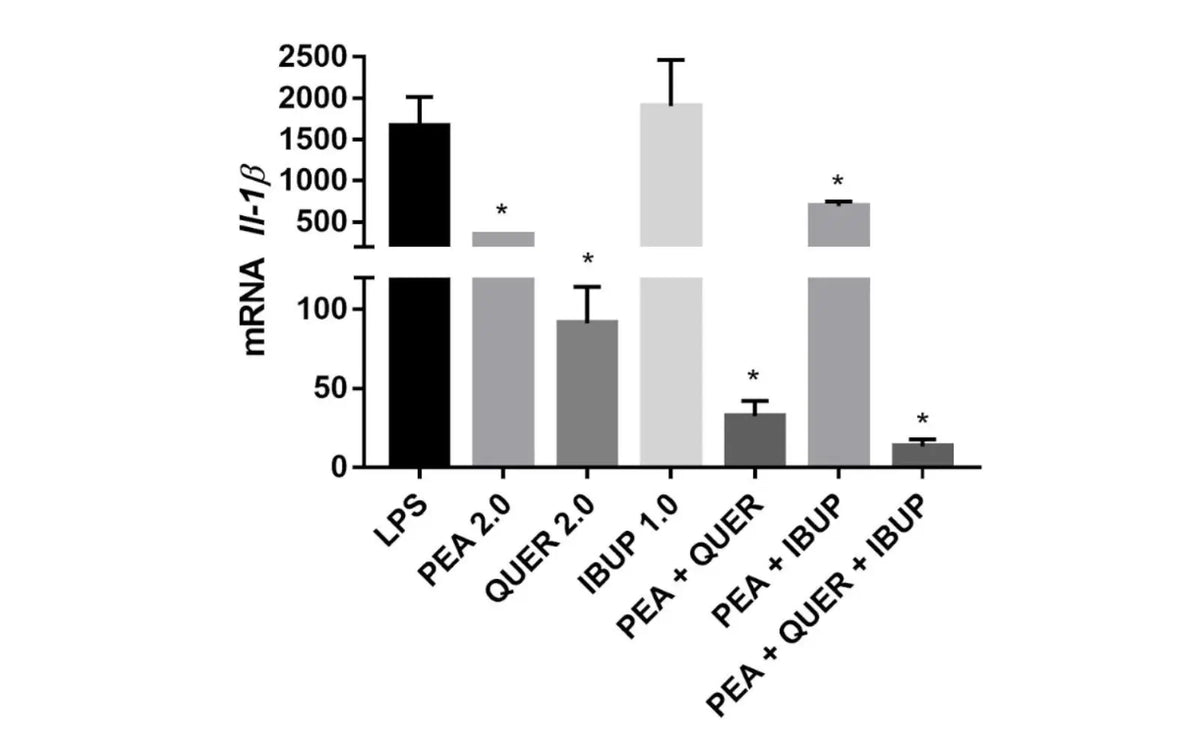
The original in-vitro work showed that the combined effect on inflammatory marker mRNA expression in activated macrophages was exponentially greater than the same concentration of any two ingredients alone. That synergy is what the US patent protects.
The peer-reviewed paper

The peer-reviewed paper behind the formula.

Britti D, Crupi R, Impellizzeri D, Gugliandolo E, Fusco R, Schievano C, Morittu VM, Evangelista M, Di Paola R, Cuzzocrea S. BMC Veterinary Research. 2017;13:229.

In 2017, BMC Veterinary Research published a peer-reviewed study evaluating the precursor formulation behind PCQ (PEA + Quercetin) in two canine pain and inflammation models. PCQ Pet is not a drug and does not claim equivalence to any prescription medication. Here is what the researchers found.

What they tested

A co-ultramicronized composite of palmitoylethanolamide and quercetin (PEA-Q) at a 5:1 ratio by mass. Administered orally to Sprague-Dawley rats.

In two pain models

Carrageenan paw oedema (acute inflammatory pain) and sodium monoiodoacetate (MIA-induced osteoarthritis), the two most reproducible rodent OA pain models in the literature.

Against a real benchmark

Meloxicam at 0.2 mg/kg, the prescription NSAID commonly used by veterinarians in Europe to treat chronic OA pain in dogs and cats.

What they found

Measure Quercetin alone
3.3 mg/kg
PEA-Q
10 mg/kg
PEA-Q
20 mg/kg
Meloxicam
0.2 mg/kg
Anti-inflammatory activity
% inhibition, paw oedema, 6h
9.75% 30.08% 45.52% 12.19%
Analgesic activity
% reduction, thermal hyperalgesia, 5h
11.76% 34.78% 57.14% 21.05%

Source: Britti et al., 2017, Figure 2. Quercetin alone at the dose used in the composite did not produce a statistically significant effect in this set of experiments. The synergy with PEA is what mattered.

Beyond the two headline numbers

Cartilage protection

In the OA model, cartilage damage measured by Mankin score went from a median of 10 (severe disorganization) in the untreated group to 4 at PEA-Q 10 mg/kg and 3 at PEA-Q 20 mg/kg. The 20 mg/kg dose protected cartilage better than meloxicam (median 4).

Inflammatory cytokines lowered

PEA-Q significantly reduced serum concentrations of TNF-α, IL-1β, and nerve growth factor (NGF), three of the central drivers of inflammation and pain in joint disease.

Cartilage-degrading enzymes lowered

Matrix metalloproteinases MMP-1, MMP-3, and MMP-9, the enzymes that break down cartilage in OA, were significantly reduced at both PEA-Q doses, comparable to meloxicam.

Motor function restored

Walking-track analysis (Sciatic Functional Index) in MIA-injected rats showed PEA-Q and meloxicam both significantly improved locomotor function at days 14 and 21, with no statistical difference between treatments.

Honest framing

  • This was a rat study. The authors note that translation to canine and feline OA pain is "currently under investigation."
  • The composite tested was PEA + Quercetin (PEA-Q). Curcuminoids were added in the later three-ingredient PCQ patent (US 11,523,998).
  • The paper is open access under CC BY 4.0.
Behind the formula

Three more pieces of evidence.

8-week pilot in family-owned dogs
Pilot study

8-week pilot in family-owned dogs

Family-owned dogs with veterinarian-diagnosed osteoarthritis. Eight weeks of daily PCQ Pet. Owner-reported pain, quality of life, and pain severity were measured with validated canine pain instruments before and after. Pre-post effect sizes were 58%, 57%, and 32%.

Read the dog study
US Patent 11,523,998
The patent

US Patent 11,523,998

Issued in 2022. The patent does not protect any one ingredient, all three are widely available. It protects the specific 5:2:1 ratio of PEA, curcuminoids, and quercetin that the in-vitro and in-vivo data both pointed to. That ratio is the moat.

View the patent
Made in the USA. Tested every batch.
Manufacturing & testing

Made in the USA. Tested every batch.

Manufactured in an FDA-registered facility in the United States. Heavy-metal panel, microbiology, and active-ingredient potency assayed every batch before any pack ships. Three ingredients, no fillers, no preservatives, no stabilizers.

Certificate of analysis
The three ingredients, deeper

What each one is. What the literature says.

If the section above was the 60-second version, this is the long answer. PubMed counts are filtered to clinical trials only and reflect the live count at time of citation.

Palmitoylethanolamide (PEA)

N-(2-Hydroxyethyl)hexadecanamide

A fatty acid amide first isolated from eggs, soybeans, and peanuts in the 1950s. Made by every cell of every mammal as part of the body's own anti-inflammatory response. Studied for decades, including by Nobel laureate Rita Levi-Montalcini for its role in immune modulation, neuropathic pain, and stabilizing histamine release related to occasional or seasonal allergies.

Used in micronized and ultramicronized formulations across human and veterinary medicine in Europe. Well-tolerated across decades of clinical use; the published trials report a strong tolerability profile.
PEA clinical trials on PubMed →

Curcuminoids

Curcuma longa, rhizome extract

The active polyphenols in turmeric root, the spice that gives curry its color. Inhibits COX-2 and iNOS, two of the central enzymes the body switches on during an inflammatory response. Used for centuries in food and traditional medicine; studied extensively in the modern literature for joint and gut applications.

Generally Recognized as Safe (GRAS) by the US FDA when used as a food ingredient.
Turmeric clinical trials on PubMed →

Quercetin

3,3',4',5,7-Pentahydroxyflavone

A flavonoid found in apples, onions, capers, berries, and dozens of other foods in the human and animal diet. A natural antioxidant that reduces reactive oxygen species (the unstable molecules that drive joint damage in OA) and synergizes with PEA on IL-1β downregulation.

Found in the human and animal food supply. Used in human supplements for decades.
Quercetin clinical trials on PubMed →
Safety

Three food-derived ingredients. Nothing else.

PCQ Pet's ingredient list is short and food-derived: palmitoylethanolamide, curcuminoids from turmeric root, and quercetin. No fillers, no preservatives, no stabilizers, no flavoring. All three ingredients are found in the human and animal food supply, and combined have been the subjects of more than 5,000 biomedical studies.

Manufactured in an FDA-registered facility in the United States. Each batch is third-party tested for heavy metals, microbiology, and active-ingredient potency before any pack ships.

Why we built it

From inflammation research to a pet supplement.

PCQ Pet was developed by Professor Susanne Talcott, PhD; Ariela Thomas, PhD; Geoff Pfeifer, PhD; and Blake Ebersole. Their original research focused on the cellular pathways of inflammation, pain, and allergies: Interleukin-1α, PPAR-α, and TNF-α. During bioactivity-guided screening, they tested numerous compounds (natural and pharmaceutical) for activity and combinatorial effects in cellular inflammation models.

The PCQ combination was discovered in 2018 after two years of work. Clinical research in family-owned dogs began in 2019 under a veterinary school director (DVM, PhD). The US patent was issued in 2022. PCQ Pet was distributed first to a selected group of veterinarians, who adopted it as a daily option to support joint comfort and a healthy inflammatory response.

For veterinarians

Open a veterinary account.

PCQ Pet has been integrated into integrative and advanced veterinary practices across the United States. We offer professional pricing, complimentary patient samples, and direct access to our medical team for case discussion and dosing questions.

Contact our medical team

Back to top

Start your 8 weeks.

Use PCQ Pet daily for eight weeks. If you do not see measurable improvement, full refund. Keep the jar.